i18n Management Platform — Full-stack
Centralise translations, coordinate teams and stay in control of every language.
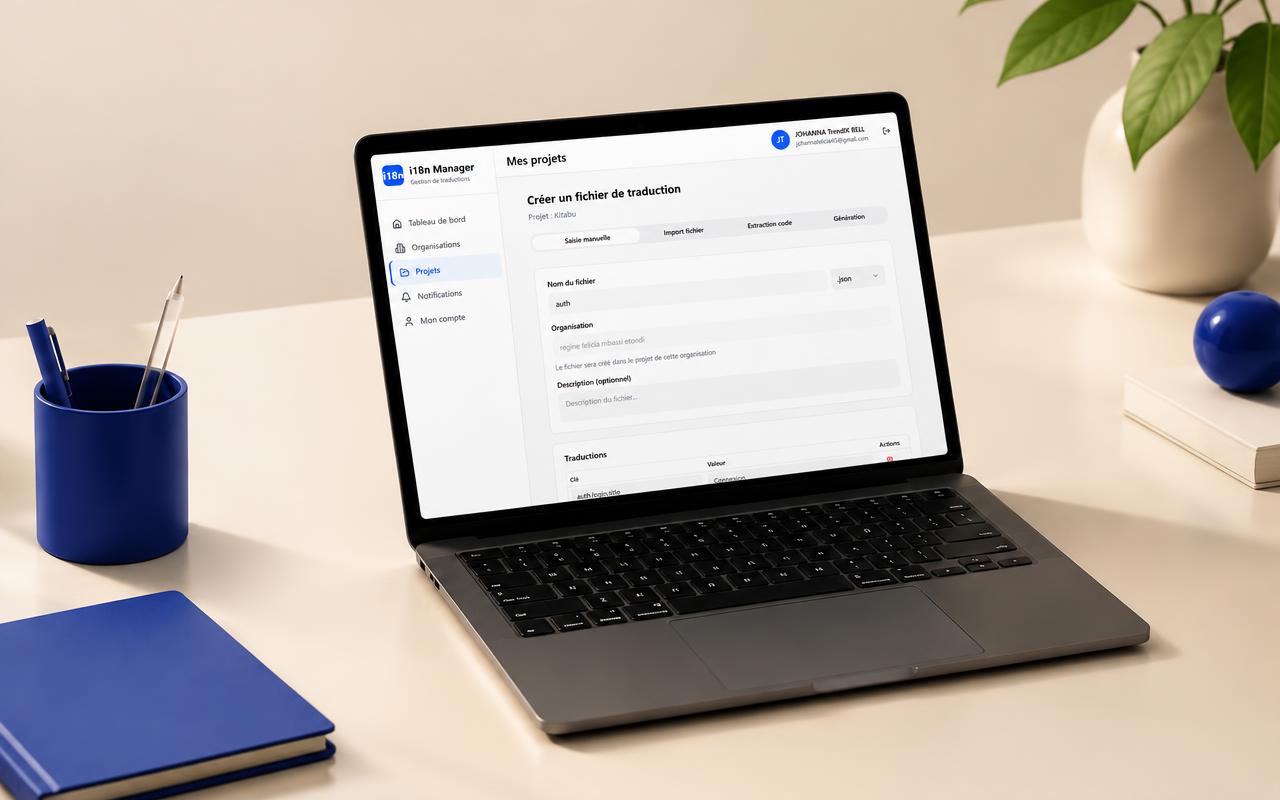
Context
Software aimed at users who speak several languages must display every string in each of those languages. This means managing thousands of strings per project and language, tracking changes, getting developers and linguists to work together, and producing files the application can use directly, without ever publishing an unreviewed translation.
However, these tasks often rely on manually exchanged files and scattered tools. It then becomes hard to know which version is current, who approved a string, or whether a translation was reviewed before going live. Teams therefore need a shared workspace that structures the work, speeds up translation and makes every decision traceable.
IMG-I18N-01 · CONTEXT
i18n Platform — context
Software must speak several languages.
Problem
How can product teams, developers and linguists work in one tool that controls access and speeds up translation with AI, while keeping human approval and reliable traceability?
Solution
Design and development of a web platform for internationalisation management, to centralise projects, translation keys and language operations. The platform organises a translate–review–approve workflow, controls access by role, offers LLM-generated suggestions and keeps the history of every version. AI speeds up the work without making decisions: no generated suggestion is published without explicit approval from an authorised user.
IMG-I18N-02 · SOLUTION
i18n Platform — solution
Scattered files, unverifiable approvals.
Contribution
Individual project. I carried out the analysis and design (UML, BPMN), then the full-stack development: React / TypeScript interface on the front-end; FastAPI REST API, role management, LLM integration and data model on the back-end.
Features
- Teams create projects, define supported languages and manage translation keys and source texts.
- Translators request an LLM suggestion (OpenAI, Gemini or DeepSeek depending on configuration), then edit it.
- Each translation follows a translate → review → approve path and can only be published after human approval.
- Four role levels determine who can read, translate, review or administer.
- Each state is saved as a JSON snapshot and every action is logged for auditing.
- Approved translation files are exported in an application-ready format.
- A REST API with over fifteen endpoints, documented with Swagger/OpenAPI, relies on nine relational tables and atomic transactions.
Architecture
When a user acts in the interface, the request reaches the FastAPI API, which first checks permissions. For assisted translation, the back-end sends the source text to the LLM provider and retrieves a suggestion, which enters the review path instead of being published. Once a reviewer approves it, the translation is stored in PostgreSQL with its history, versioned and made available for export.
IMG-I18N-03 · ARCHITECTURE
i18n Platform — overall architecture
Users act through the interface.
Stack
React, TypeScript, Tailwind CSS, Python, FastAPI, PostgreSQL, LLM APIs (OpenAI, Gemini, DeepSeek), REST, Swagger/OpenAPI, UML, BPMN.
To verify: the report sometimes mentions MongoDB; confirm PostgreSQL in the deployed version.
Benefits
- All multilingual resources live in one place, with a clear reference version.
- Every contributor knows their role and permissions.
- AI speeds up translation preparation without bypassing human review.
- History and audit logs show at any time who approved what.
Links
This case study distinguishes the overall project scope from my personal contribution. No undocumented result or metric is presented.