Residence Management Platform
Bring room reservations and administration of a student residence together.
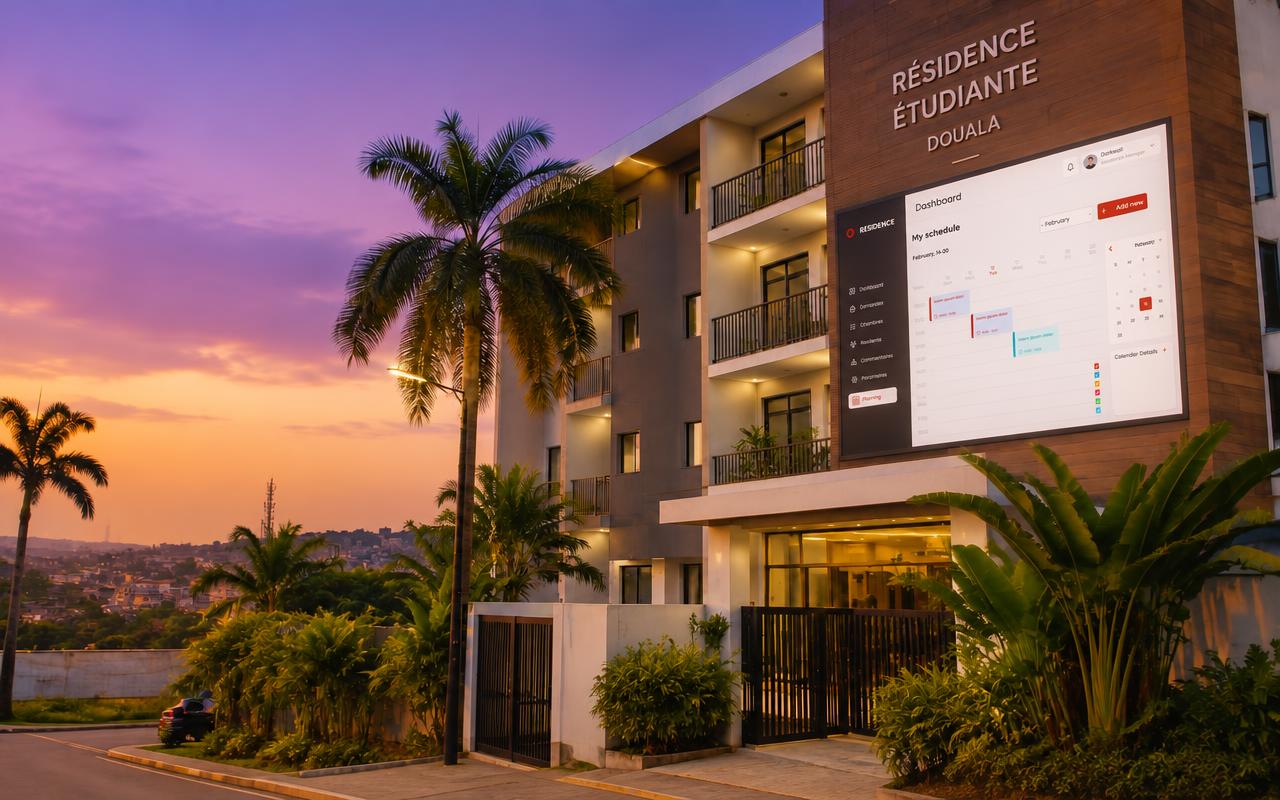
Context
UCAC-ICAM hosts students in its residence in Douala. Running it involves presenting available rooms, receiving and processing reservation requests, allocating rooms and following residents throughout their stay.
These operations relied on manual exchanges and multiple files. This fragmentation reduced staff efficiency, made request follow-up harder and weakened data consistency: the same information could exist in several versions or get lost between exchanges. Students therefore needed an online reservation journey, and staff a single management tool.
IMG-RES-01 · CONTEXT
Residence Management — context
UCAC-ICAM hosts students in Douala.
Problem
How can students book online while administrative staff have a separate, reliable space to manage residents?
Solution
Development of two complementary applications connected to one back-end, to centralise reservations and administrative management. The first, public, lets students and prospective residents discover the residence and submit a request. The second, internal, lets staff follow requests and residents using the same data.
IMG-RES-02 · SOLUTION
Residence Management — solution
Scattered requests, inconsistent data.
Contribution
Full-stack team development of both applications (React front-end and Express.js / PostgreSQL back-end), followed by maintenance and evolution over the documented period.
Features
- Students view residence information and accommodation options.
- They submit their reservation request online.
- Staff follow requests and residents from a dedicated interface.
- All reservation and management data is stored in a shared database.
To verify: availability, allocation, payment and notification rules, and administrative roles.
Architecture
When a student submits a request, the reservation interface sends it to the Express.js back-end, which applies business rules and stores it in PostgreSQL. Staff find the same request in the management interface, which queries the same back-end. Both audiences therefore work from a single data source.
IMG-RES-03 · ARCHITECTURE
Residence Management — overall architecture
The student browses and submits a request.
Stack
React / JavaScript, Node.js / Express.js, PostgreSQL.
Benefits
- Reservations are available online, without manual steps.
- Staff have a dedicated tool, separate from the student journey.
- A single database removes duplicates and improves data consistency.
- Request follow-up becomes simpler and faster.
Links
residence-douala.icam-afrique.com/residence/1 · Frontend: github.com/JOHANNABELL/residence_management_frontend
This case study distinguishes the overall project scope from my personal contribution. No undocumented result or metric is presented.